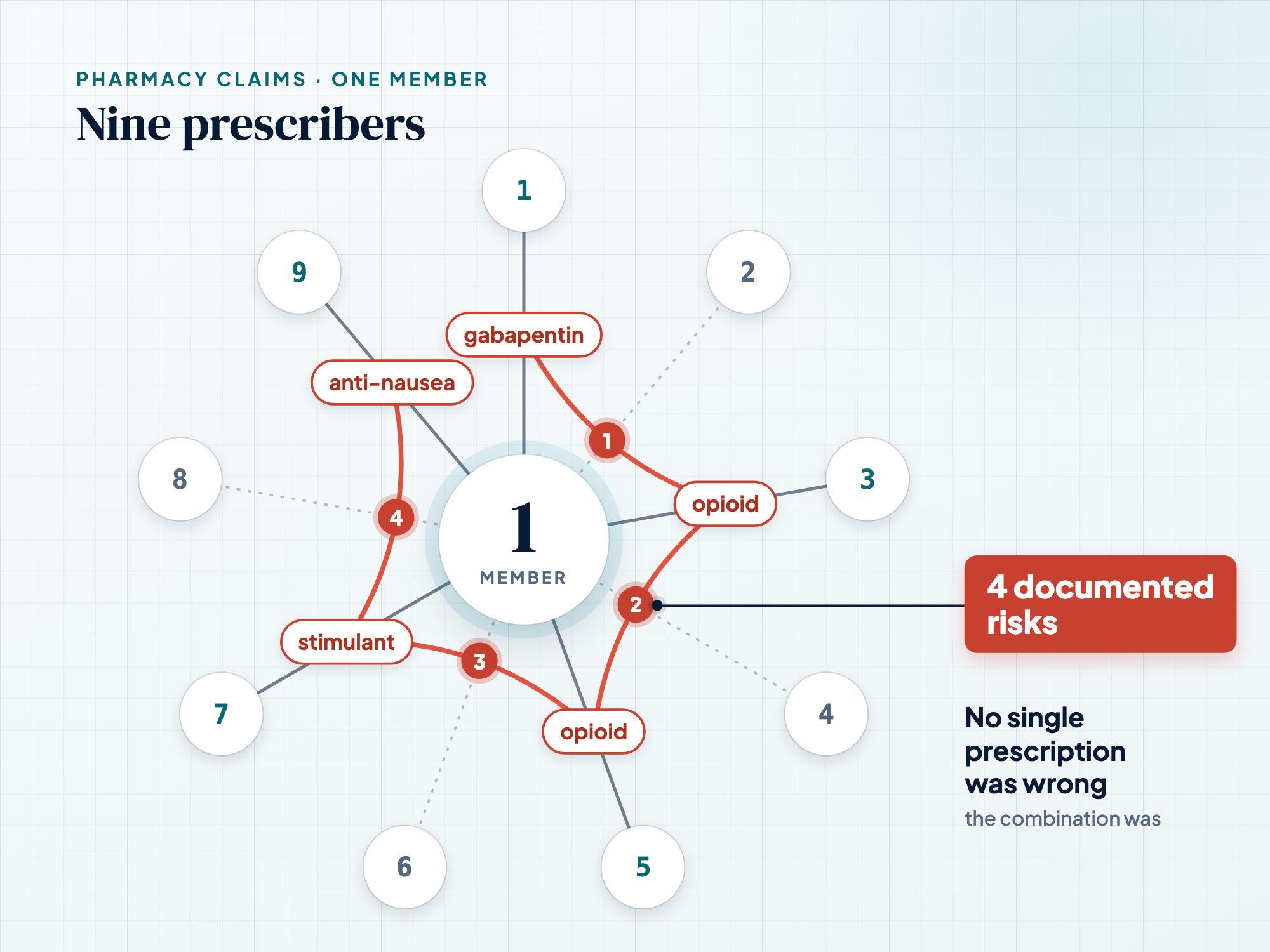
Nine clinicians wrote prescriptions for one member. As far as the claims show, none of them did anything wrong.
One prescribed gabapentin. Two, in different settings, prescribed opioids. One prescribed a stimulant-class anti-obesity drug. One added an anti-nausea agent. Every fill was dispensed and paid. Each prescription was defensible on the day it was written, for the complaint in front of the clinician who wrote it, and nothing in any single encounter would have prompted a call.
Together, the regimen reads differently. Gabapentin taken with opioids raises the risk of respiratory depression. The FDA said so in December 2019, and it singled out patients who also take other central-nervous-system depressants.1 A second opioid on top of the first compounds that risk. The stimulant does something subtler and worse: it masks the sedation and the slowed breathing that would otherwise warn the patient, or someone near them, that the opioids were winning. The anti-nausea agent, combined with a stimulant, raises the risk of serotonin syndrome.
No clinician saw that paragraph. Each saw one sentence of it.
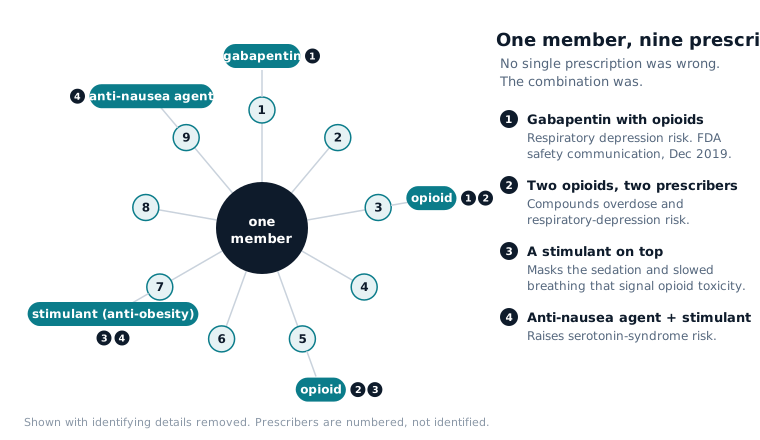
The case is shown with identifying details removed. Patterns like it can surface from pharmacy claims alone, before the medical claims that would add the diagnoses are joined to them.
The dollars involved can be small. The risk to the member is not.
Why nobody saw it
The instinct is to ask which clinician should have caught this. It is the wrong question, and the reason it is wrong is also the reason the problem persists.
Care is fragmented by design. A member with chronic pain, obesity and a gastrointestinal complaint will legitimately see several specialists, and a health system’s record stops at the health system’s door. Prescription drug monitoring programs help, but they are state-bound, prescriber-facing, and consulted at the point of prescribing, before the ninth prescription exists. One party receives every prescription and every medical claim for that member, from every prescriber and every pharmacy: the plan. It receives them after the fact, into an adjudication queue, where the question asked of each claim is whether it is payable, and never what the member’s regimen looks like now.
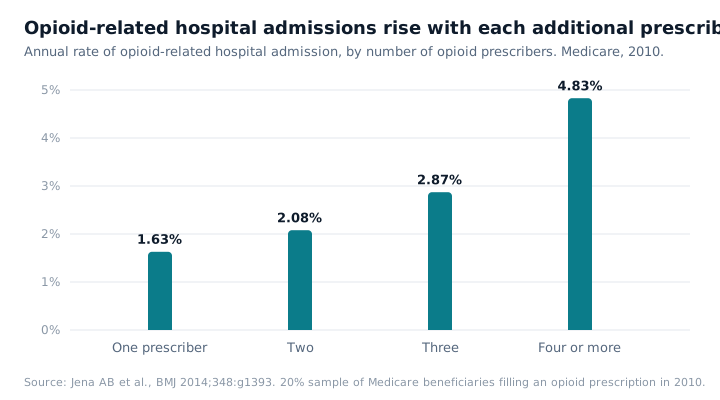
The measurement community has known for a decade that the count of prescribers is itself a risk signal. NCQA’s HEDIS measure Use of Opioids From Multiple Providers exists because members who receive opioids from four or more prescribers, or four or more pharmacies, have a higher likelihood of opioid-related overdose death.2 The evidence behind the measure is stark. A 2014 study of 1.8 million Medicare beneficiaries found that opioid-related hospital admissions rose with each additional prescriber: 1.63% a year for members with one prescriber, 2.08% with two, 2.87% with three, and 4.83% with four or more, nearly triple the single-prescriber rate.3
| Prescribers in the year | Annual rate of opioid-related hospital admission |
|---|---|
| One | 1.63% |
| Two | 2.08% |
| Three | 2.87% |
| Four or more | 4.83% |
Source: Jena AB et al., BMJ 2014, a 20% sample of Medicare beneficiaries who filled an opioid prescription in 2010.3
The member above had nine.
The guidance is well known. The CDC’s 2022 opioid prescribing guideline asks clinicians to review the patient’s history of controlled-substance prescriptions and to weigh the risks of concurrent central-nervous-system depressants.4 The FDA’s 2016 boxed warning states that combining opioids with benzodiazepines or other CNS depressants “may result in profound sedation, respiratory depression, coma, and death.”5 All of it assumes that someone can see the whole regimen. In a fragmented system, that someone is the payer, or it is no one.
GLP-1s are the same problem with a newer drug
If opioids are the established version of this story, GLP-1 agonists are the current one.
GLP-1 drugs are estimated to account for 14% of all prescription drug spending in 2026, after national spending on the class rose from $13.7 billion in 2018 to $71.7 billion in 2023.6 Pharmacy is now a quarter of employer health spending, and the share of employers covering GLP-1s for obesity fell from 72% in 2025 to 60% in 2026 as the bills came in.7 The cost is well documented. The safety questions are newer.
In June 2025 the European Medicines Agency’s safety committee concluded that non-arteritic anterior ischemic optic neuropathy (NAION), a sudden and usually permanent loss of vision in one eye, is a very rare side effect of semaglutide. It recommended that the product information be updated.8 The World Health Organization issued its own advisory the same month.9 In the United States, the vision-loss lawsuits against the manufacturers were consolidated into a federal multidistrict litigation in December 2025; as of September 2026, 216 actions were pending in it.10
For a clinical operations leader the relevant point is not the litigation. The utilization patterns that precede harm are the same patterns that precede waste, and both are visible first in claims: two GLP-1 products dispensed to one member in the same month; doses stepping past the label; refills that arrive early; prescriptions from a telehealth prescriber and a primary-care office that have never spoken; a compounded product and a branded one, overlapping. None of these is proof of anything. Each is a reason for a clinician to look.
What a member-level view actually is
Finding a member like this takes nothing a pharmacist could not do with the same data and a free afternoon. A detection agent does it for every member, on every claim, as the claim arrives, and then writes down why.
A flag that says high risk is an interruption. A flag that shows its work is a case file: this member has active fills for gabapentin, two opioids from two prescribers, a CNS stimulant and a serotonergic antiemetic; here are the nine prescribers, the fill dates, the days’ supply, and the two FDA safety communications that apply. The first goes to a queue. The second goes to a clinician, who can act on it in the time it takes to read it.
That is the standard we hold the platform to. Every claim is read before it is paid. The member’s regimen is assembled across prescribers and pharmacies. A flag is raised only when a pattern, never a single drug, meets a defined rule. And every flag carries an evidence chain that a medical director can hand to a treating physician without embarrassment. The clinician decides what to do. The system’s job is to make the decision possible.
Three questions to ask your data this quarter
- How many members received opioids from four or more prescribers last year? If the answer is “we would have to run that,” nobody is watching it.
- When a member’s regimen crosses an FDA boxed warning, who is told, and when? At most plans the honest answer is no one, and never.
- For GLP-1s, can you see overlapping products, early refills and multiple prescribers for one member, across the PBM feed and the medical claims together? If the two feeds are never joined, the pattern does not exist anywhere.
The claims hold the answers to all three. Someone has to read them.
Sources
-
U.S. Food and Drug Administration, 19 December 2019: serious breathing problems with gabapentin and pregabalin, particularly with concomitant CNS depressants including opioids. https://www.fda.gov/safety/medical-product-safety-information/neurontin-gralise-horizant-gabapentin-and-lyrica-lyrica-cr-pregabalin-drug-safety-communication ↩
-
NCQA, HEDIS measure Use of Opioids From Multiple Providers (UOP): members on opioids for 15 or more days who receive prescriptions from four or more prescribers and/or four or more pharmacies. https://www.ncqa.org/report-cards/health-plans/state-of-health-care-quality-report/use-of-opioids-from-multiple-providers-uop/ ↩
-
Jena AB, Goldman D, Weaver L, Karaca-Mandic P. Opioid prescribing by multiple providers in Medicare: retrospective observational study of insurance claims. BMJ 2014;348:g1393. https://pubmed.ncbi.nlm.nih.gov/24553363/ ↩ ↩2
-
Centers for Disease Control and Prevention. CDC Clinical Practice Guideline for Prescribing Opioids for Pain, United States, 2022. MMWR Recomm Rep 2022;71(No. RR-3). https://www.cdc.gov/mmwr/volumes/71/rr/rr7103a1.htm ↩
-
U.S. Food and Drug Administration, 31 August 2016: boxed warnings required on prescription opioid pain and cough medicines and on benzodiazepines, for the risks of using them together. https://www.fda.gov/drugs/food-and-drug-administration-overdose-prevention-framework/new-safety-measures-announced-opioid-analgesics-prescription-opioid-cough-products-and ↩
-
HFMA, GLP-1 coverage costs pressure employers and Medicare plans in 2026, 9 May 2026: national GLP-1 spending $13.7B (2018) to $71.7B (2023); an estimated 14% of all prescription drug spending in 2026. https://www.hfma.org/payment-reimbursement-and-managed-care/glp-1-coverage-costs/ ↩
-
Insurance Business, Employers cut GLP-1 coverage as pharmacy costs hit 25% of health spend, 27 August 2026, citing the Business Group on Health 2027 Employer Health Care Strategy Survey. https://www.insurancebusinessmag.com/us/news/benefits/employers-cut-glp1-coverage-as-pharmacy-costs-soar-587708.aspx ↩
-
The Pharmaceutical Journal, Eye disorder is a ‘very rare’ side effect of weight-loss drugs, concludes EMA review, reporting the EMA PRAC conclusion of 6 June 2025. https://pharmaceutical-journal.com/article/news/eye-disorder-is-a-very-rare-side-effect-of-weight-loss-drugs-concludes-ema-review ↩
-
World Health Organization, The use of semaglutide medicines and risk of non-arteritic anterior ischemic optic neuropathy (NAION), 27 June 2025. https://www.who.int/news/item/27-06-2025-27-06-2025-semaglutide-medicines-naion ↩
-
GLP-1 NAION litigation, MDL No. 3163 (E.D. Pa.), created 15 December 2025; 216 pending actions per the Judicial Panel on Multidistrict Litigation’s 1 September 2026 report, as summarized at https://www.lanierlawfirm.com/pharmaceutical-liability/ozempic-glp1-naion-blindness-lawsuit/ ↩