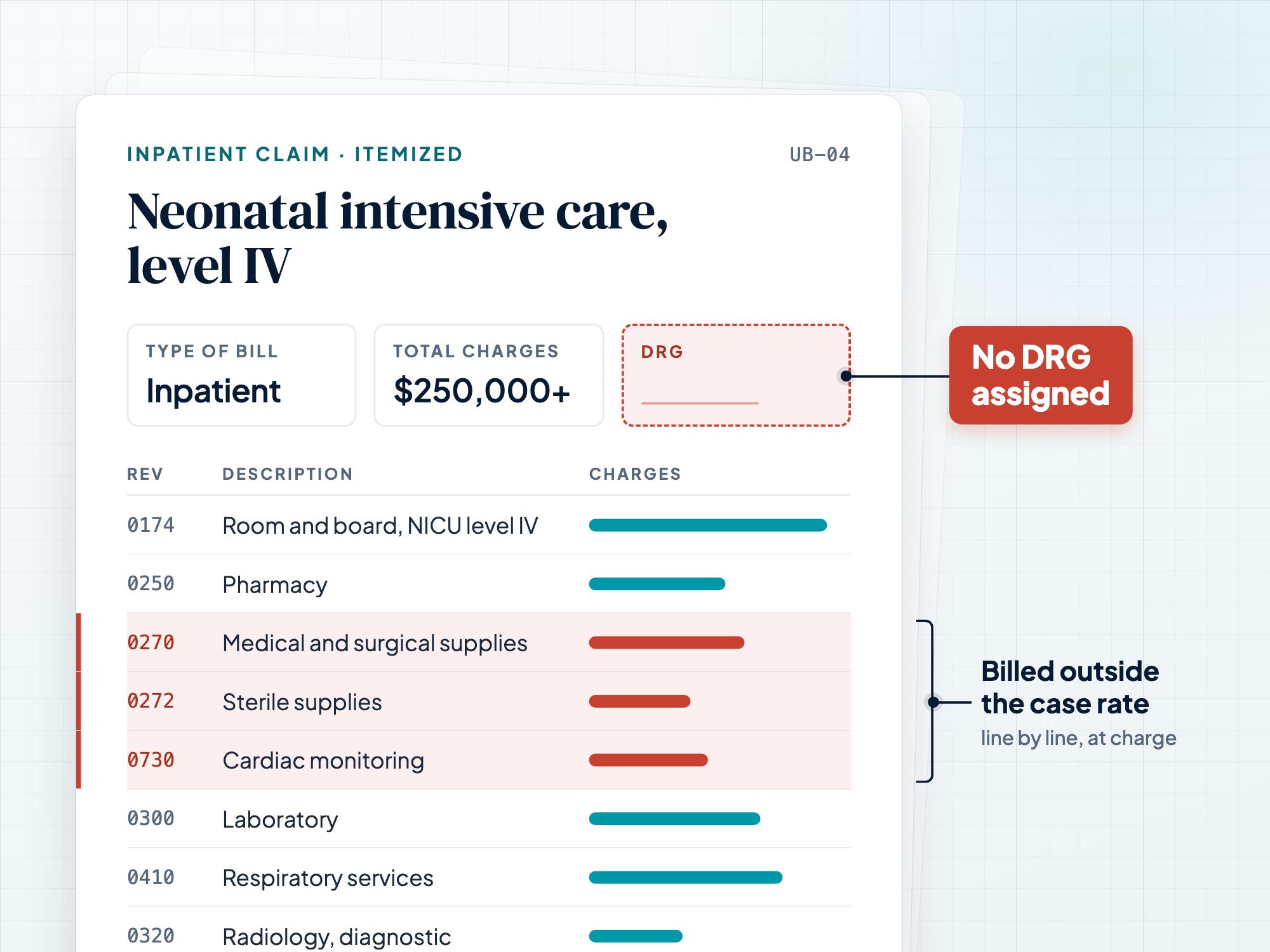
Picture a claim for a level-4 neonatal intensive care stay of several weeks. The billed amount is more than $250,000. It carries no DRG. Nothing on it is bundled.
Weeks in a level-4 NICU are, medically, exactly what they sound like: the sickest newborns, and the most intensive care a hospital can provide. Nobody disputes that the stay is expensive. The question a claims examiner should ask is narrower. An inpatient stay is supposed to arrive grouped, under a diagnosis-related group that fixes the case rate and pulls the room, the monitoring, the supplies and the routine services into it. This one arrives as an itemized list. Supplies and services that belong inside a bundled rate are billed beside it, separately, at charge. On a single claim like this, the charges a facility-unbundling check would test can run past $250,000.
Whether anyone tests it depends on whether the detail on the facility claim (the DRG, the revenue codes, the modifiers) ever reaches the payment-integrity function. Often it does not.
A second pattern looks different on paper. A claim for more than $250,000 is billed under a high-severity cardiac surgical DRG, the group for valve and other major cardiothoracic procedures, while its principal diagnosis is a benign growth in the abdomen. A benign abdominal growth does not, on its own, support a cardiac surgical DRG. That is the signature of upcoding: the severity billed is not supported by the diagnoses on the claim. On a claim of that size, the exposure can be most of what was billed.
Two claims like these can carry more than $500,000 of exposure between them. They tend to surface, if they surface at all, long after they have been paid.
The federal record says this is common
The temptation is to treat these as outliers. The government’s own auditors say otherwise.
The HHS Office of Inspector General looked at six years of Medicare inpatient claims and found that stays billed at the highest severity level rose almost 20% between 2014 and 2019, to account for nearly half of all Medicare spending on inpatient stays. Over the same years, the average length of those high-severity stays fell.1 Sicker on paper, shorter in the bed. The OIG concluded that the trend “warrants further scrutiny.” That was in 2021.
The Medicare fee-for-service improper payment rate for fiscal 2025 was 6.55%, or $28.8 billion.2 That is the rate in the program with the most edits, the most auditors and the most prepayment scrutiny in American healthcare. A self-funded employer plan administered through a TPA has fewer edits, not more. The industry’s anti-fraud association estimates that fraud alone costs between 3% and 10% of healthcare spending, before waste and error are counted.3
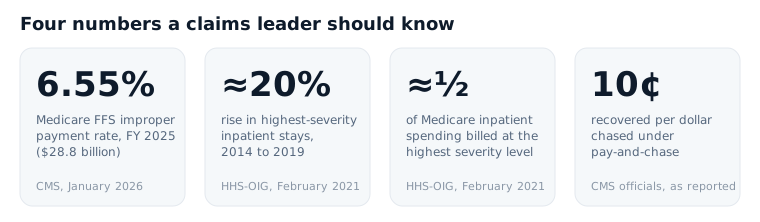
None of these figures is about NICU claims or cardiac DRGs specifically. All of them describe the same mechanism. A claim arrives carrying a severity, a code, a bundle or a diagnosis that the rest of the claim does not support, and the adjudication system pays it. The system was built to check eligibility and coverage; nothing in its workflow asks whether the claim is internally consistent.
Why pay-and-chase cannot fix this
Most TPAs already have a post-payment program. A vendor pulls a sample of paid claims, finds what it finds, sends demand letters, and keeps a share of what comes back. It helps. It cannot close the gap, for three reasons.
It recovers a fraction. CMS officials have put the recovery rate of the pay-and-chase model at roughly ten cents of every dollar chased.4 The money has been paid, the provider has spent it, the appeal window is open, and the plan is now a creditor.
Federal policy has moved away from this model. In February 2026 the Secretary of HHS announced that the government is “replacing the old ‘pay and chase’ model with a real-time ‘detect and deploy’ strategy” to stop improper payments “before they go out the door.” CMS had suspended $5.7 billion in suspected fraudulent Medicare payments in 2025.5 In the 2025 national takedown, CMS reported preventing more than $4 billion in fraudulent payments before they were made.6 The largest payer in the country has concluded that prepayment is the only position from which the numbers work.
It samples. A post-payment audit reads a few percent of claims, months later. An inpatient claim over $250,000 with no DRG is one line among hundreds of thousands. A sample rarely lands on it.
It arrives without evidence. A recovery demand that says we believe this was overpaid invites an appeal. A demand that carries the evidence is a different document: this claim was billed under a cardiac surgical DRG with a principal diagnosis that maps to a different DRG family; here is the grouper logic, the expected case rate and the dollar difference. Evidence turns a flag into money, and evidence is far easier to assemble at the moment of adjudication, while the claim is still a question, than eighteen months later when it has become a dispute.
The funnel
Across the books we have run, roughly 5.5% of a book draws a flag of some kind. Of that, 1.5% to 2% turns out to be actionable: a denial, a reduction, or a recovery that survives the provider’s response.
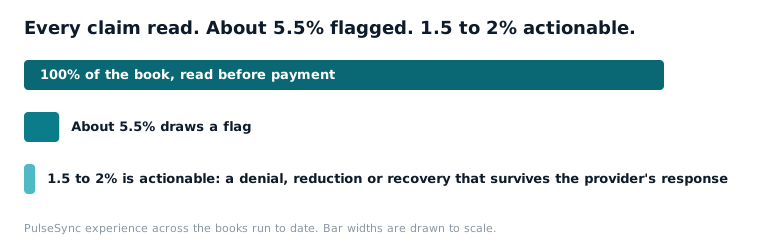
We show the whole funnel because the gap between 5.5% and 1.5% is where payment-integrity programs succeed or fail. A system that flags 5.5% and hands all of it to examiners has created work, not savings.
What separates a flag from an actionable flag is the evidence chain: which rule fired, on which fields, against which reference (the NCCI edit, the DRG grouper, the FDA release date, the invoice requirement), and what the dollar delta is if the rule holds. When that chain is attached to every flag, the 1.5% routes itself: to a denial with the letter drafted, to a reduction with the rate recalculated, or to a recovery queue with the demand ready to send. The other 4% closes in seconds, because the examiner can see at a glance why the rule fired and why it does not apply.
A small pattern makes the point better than a large one. Picture a primary-care practice billing HCPCS J3490, unclassified drugs, against routine office diagnoses. J3490 exists for drugs that have no code yet, which in practice means a drug the FDA has just released. A claim using it is payable only when the drug name, dosage and NDC are supplied and the invoice supports the charge.78 With no drug identified, each claim is worth a few hundred dollars. The pattern is worth far more: a practice that has learned that an unclassified code passes edits a named drug would not. It is also exactly the kind of thing a post-payment sample never sees, because no single claim is large enough to sample.
What prepayment review has to be
Precision matters here, because “prepayment review” is also what a payer calls a pended claim and a fax to a provider.
Every claim, not a sample. The platform reads each claim as it arrives, in seconds, so the review sits inside the adjudication window rather than after it. A weeks-long NICU stay with no DRG does not depend on anyone noticing.
Patterns, beyond edits. Claim edits catch invalid codes. The failures above were valid codes in impossible combinations: a high-severity cardiac DRG with an abdominal diagnosis; an inpatient stay itemized as if it were outpatient supplies; an unclassified drug code on an office visit. Each of those is a relationship between fields, and it takes a detector built for the relationship to see it.
Evidence on every flag. The reasoning, the fields it used, the reference it checked and the dollars at stake are attached before the examiner opens the case. An automatic denial shows its qualifying criteria. A recommendation shows why it stopped short of one.
A person on the decision. The system flags and explains. Your examiner, your medical director or your SIU decides. Autonomy is set per decision type, and the platform cannot exceed the level you set.
Without a prepayment read, claims like the two above are caught late and by chance, if at all. The point of prepayment review is that the looking, the doubting and the evidence are already done by the time a claim reaches a person: for the few claims that deserve a person’s attention, and for the rest, which do not.
Ask your adjudication platform one question this week. On the last facility claim over $300,000 that you paid, what did anyone read before the check went out?
Sources
-
U.S. Department of Health and Human Services, Office of Inspector General. Trend Toward More Expensive Inpatient Hospital Stays in Medicare Emerged Before COVID-19 and Warrants Further Scrutiny. OEI-02-18-00380, February 2021. https://oig.hhs.gov/oei/reports/OEI-02-18-00380.pdf ↩
-
Centers for Medicare & Medicaid Services. Fiscal Year 2025 Improper Payments Fact Sheet, 15 January 2026: Medicare FFS improper payment rate 6.55% ($28.83 billion), down from 7.66% ($31.70 billion) in FY 2024. https://cms.gov/newsroom/fact-sheets/fiscal-year-2025-improper-payments-fact-sheet ↩
-
National Health Care Anti-Fraud Association. The Challenge of Health Care Fraud: a conservative estimate of 3% of total health care expenditures; some government and law-enforcement agencies place the loss as high as 10%. https://www.nhcaa.org/tools-insights/about-health-care-fraud/the-challenge-of-health-care-fraud/ ↩
-
Arrington J, Moore B. We’re being defrauded out of $1 million every minute, Washington Examiner op-ed, reporting CMS officials’ estimate that the current system recovers about ten cents of every dollar it chases. https://www.washingtonexaminer.com/op-eds/4706674/medicare-fraud-prevention-anti-fraud-fund-act-jodey-arrington-blake-moore/ ↩
-
Centers for Medicare & Medicaid Services, press release, 25 February 2026: “replacing the old ‘pay and chase’ model with a real-time ‘detect and deploy’ strategy”; $5.7 billion in suspected fraudulent Medicare payments suspended in 2025. https://www.cms.gov/newsroom/press-releases/trump-administration-prioritizes-affordability-announcing-major-crackdown-health-care-fraud ↩
-
U.S. Department of Justice, National Health Care Fraud Takedown Results in 324 Defendants Charged in Connection with Over $14.6 Billion in Alleged Fraud, 30 June 2025, including CMS’s prevention of over $4 billion in fraudulent payments. https://www.justice.gov/opa/pr/national-health-care-fraud-takedown-results-324-defendants-charged-connection-over-146 ↩
-
Centers for Medicare & Medicaid Services, Medicare Coverage Database, Billing and Coding Article A54880, Additional Claim Documentation Requirements for Not Otherwise Classified (NOC) Drugs and Biological Products: NOC drug claims must carry the drug name, NDC and total dosage. https://www.cms.gov/medicare-coverage-database/view/article.aspx?articleId=54880 ↩
-
Noridian Healthcare Solutions (Medicare Administrative Contractor), Unlisted and Not Otherwise Classified Code Billing: drug name and dosage required; claims missing the information are unprocessable. https://med.noridianmedicare.com/web/jfb/topics/claim-submission/submission-errors-solutions/unlisted-procedure-and-noc-codes ↩