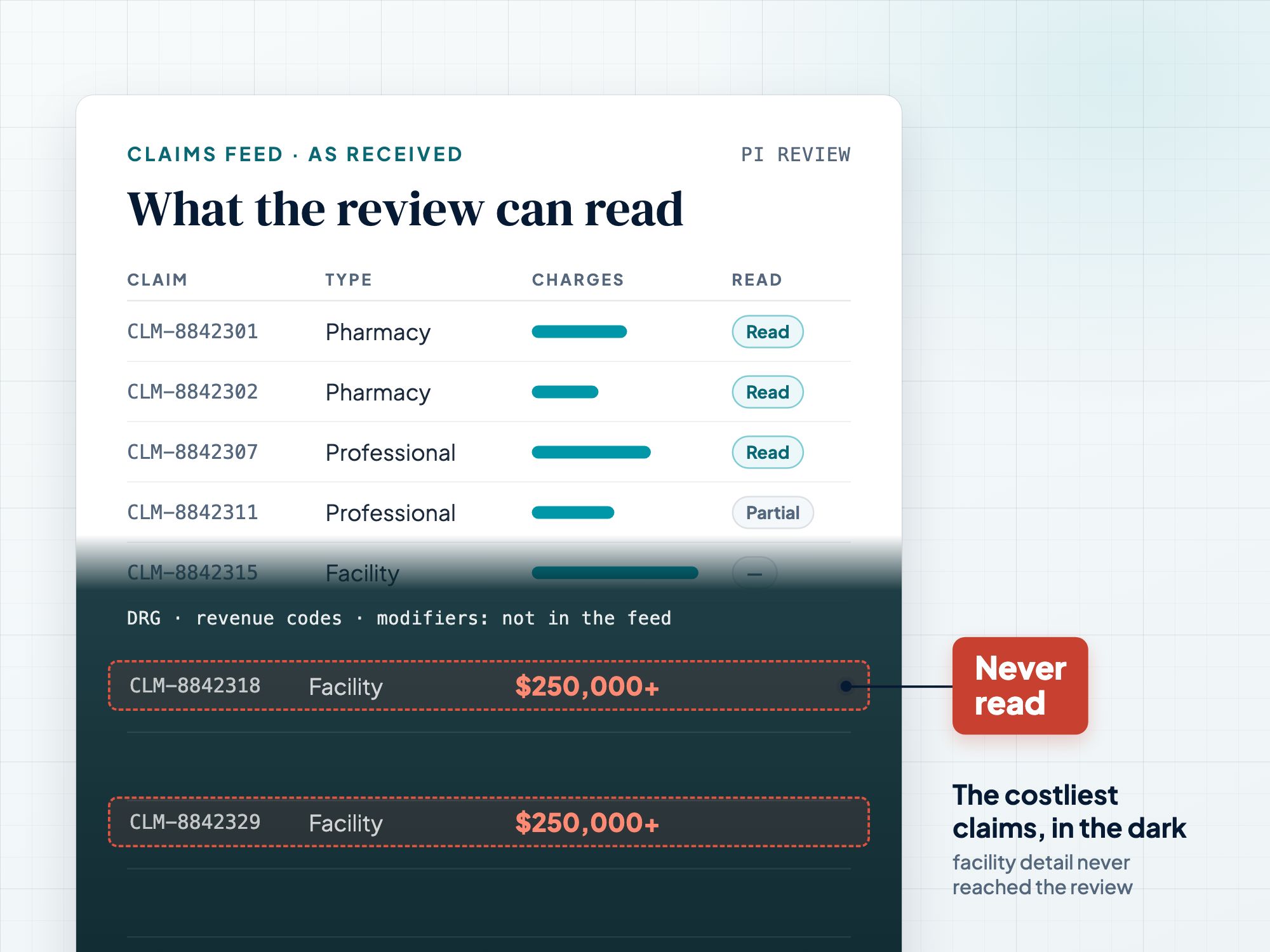
Point a set of detection agents at a TPA’s claims feed, and what they can read depends less on the agents than on the feed.
The agents that read prescriptions usually have what they need. The agents that read facility claims, where the largest dollars sit, often do not: the DRG, the revenue codes and the modifiers they test may never reach the payment-integrity function at all. When that detail is missing, whole classes of detection go dark, not because the patterns are absent, but because nobody asked for the data.
What sits in that dark part of the book is not small: a weeks-long level-4 neonatal intensive care stay billed line by line, with no DRG and nothing bundled; a high-severity cardiac surgical DRG on a claim whose principal diagnosis is a benign abdominal growth. Either can run past $250,000, two together past $500,000, and neither is visible to a review that only sees summaries.
A chief executive does not need to know what a revenue code is to see the shape of that problem. The question it raises is how much of the book anyone can see.
Why the blind spot exists
A TPA sees what its adjudication platform stores, in the shape the platform stores it. Facility claims are often summarized on the way in. Professional claims arrive as lines. Pharmacy lives in a separate feed from the PBM, joined to medical rarely or never. Out-of-network claims go to a repricing vendor and come back as a number. Each system answers its own question well. None was built to answer the question that matters to the person who signs the stop-loss renewal: is this book being billed honestly, and would we know if it were not?
The out-of-network piece alone has become a volume business. The No Surprises Act’s dispute process was designed for about 17,000 disputes a year. Providers filed 1.2 million in the first half of 2025, more than double the same period of 2024, and roughly 4.8 million in total by the end of 2025.1 Ten initiating parties accounted for almost 70% of them.1 That is a story about an industry that has learned where the seams in a payer’s visibility are, and has organized around them.
The adversary has industrialized
The other reason to worry about what you cannot see is who is looking at the same gaps from the other side.
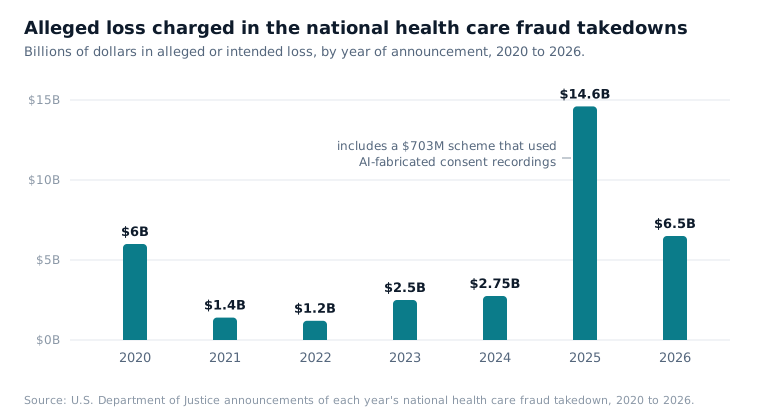
Read the last seven national health care fraud takedowns as a series rather than as headlines. In 2020, more than $4.5 billion of the $6 billion charged involved telemedicine.2 In 2021, telemedicine schemes were about $1.1 billion of the $1.4 billion charged.3 In 2022, more than $1 billion of $1.2 billion.4 In 2023, more than $2 billion of $2.5 billion.5
The record year, 2025, charged 324 defendants with $14.6 billion in intended loss, and one of its centerpiece cases was a $703 million scheme in which the defendants allegedly used artificial intelligence to create fake recordings of beneficiaries consenting to products they never asked for.6 The 2026 action charged 455 defendants with $6.5 billion, alongside a previously charged $1.2 billion telemedicine and equipment scheme; CMS suspended 1,079 providers and revoked billing privileges for 1,403 more.78
| Year | Defendants charged | Alleged or intended loss |
|---|---|---|
| 2020 | 345 | $6.0 billion, more than $4.5 billion of it telemedicine |
| 2021 | 138 | $1.4 billion, about $1.1 billion of it telemedicine |
| 2022 | 36 | $1.2 billion, more than $1 billion of it telemedicine |
| 2023 | 78 | $2.5 billion, more than $2 billion of it telemedicine |
| 2024 | 193 | $2.75 billion |
| 2025 | 324 | $14.6 billion, including a $703 million AI-fabricated-consent scheme |
| 2026 | 455 | $6.5 billion |
Sources: U.S. Department of Justice announcements for each year.234567
Two constraints on fraud fell away in the same few years. Telehealth removed the physical one. A prescriber in one state, a patient in another, a laboratory in a third, and no examination room anywhere. That is why the HHS Inspector General, reviewing the first year of pandemic telehealth, found 1,714 providers whose billing posed a high risk to Medicare. They were paid $127.7 million, and more than half of them were in practices with at least one other high-risk provider.9
Generative AI removed the cost constraint on fabrication. The FBI’s public warning of December 2024 is plain about what the technology gives a criminal: realistic images and documents for identity fraud, cloned voices, and fictitious profiles, at scale and for almost nothing.10 A fabricated consent recording was the 2025 example. A fabricated operative note, a fabricated prior-authorization packet or a fabricated telehealth encounter narrative costs the same.
When the document can be manufactured, the document stops being the evidence. What cannot be manufactured is the pattern: a member with nine prescribers; a provider billing more hours in a day than the day contains; a cardiac surgical DRG carrying an abdominal diagnosis; a practice whose “unclassified” drugs never acquire a name; twelve providers in twelve states submitting narratives with the same sentence structure. Patterns live across claims, not inside any one of them. The only defense that scales is reading all of them, together, before the money moves.
Seeing costs less than you think, and more than you are spending
It would be convenient to say the fix is a new system. Mostly it is not. It comes down to two decisions.
The first is a data contract. The facility checks need detail that often never reaches them. Every hospital bill has a DRG, revenue codes and modifiers on it somewhere; whether they reach your payment-integrity function, in what shape, and when, is a leadership decision disguised as an IT ticket. It is also the cheapest fraud control you will ever buy, because until it is made, every downstream tool is reading a summary.
The second is position. Federal policy moved this year from “pay and chase” to what the Secretary of HHS called “detect and deploy,” stopping improper payments “before they go out the door.” CMS had suspended $5.7 billion in suspected fraudulent Medicare payments in 2025.11 The largest payer in the country decided that review has to sit before payment, on every claim, or the recovery arithmetic does not work. The arithmetic is the same for a book of 200,000 lives.
Our own position is simple to state. Every claim is read before it is paid, in seconds. The reading is done by detectors built for specific patterns (unbundling, upcoding, unsafe prescribing, phantom billing, duplicate submission), each of which writes down its reasoning, the fields it used and the reference it checked. Every flag carries that evidence, so that when your people act on it, the action survives an appeal, an audit or a hearing. And autonomy is yours to set, per decision type, with a person governing the boundary. We are not asking a TPA to trust a model. We are asking it to look at what the model found, and decide.
Four questions for your next leadership meeting
- What share of claim dollars did anyone, person or system, read before payment last quarter? Not sampled afterwards. Read before.
- Which fields never reach our payment-integrity function? Ask for the list. If it includes DRG, revenue codes, modifiers or rendering provider, your facility book is unreviewed.
- When an inpatient claim over $250,000 arrives with no DRG, who notices, and how long does it take? If the answer is a retrospective audit, the money has already gone.
- If we denied a claim on our vendor’s recommendation and the provider took it to a hearing, could we show the evidence? A flag with no evidence behind it is an opinion, and opinions lose hearings.
Claims like these are often already paid by the time anyone looks. They sit in the data, unread, the way most of it is at most plans. What you can’t see is not hypothetical. It has a claim number.
Sources
-
Health Affairs Forefront, The No Surprises Act IDR Process: An Early Look At 2025 Data: 1.2 million disputes in the first half of 2025 versus about 590,000 in the first half of 2024; the top ten initiating parties nearly 70% of disputes; a process designed for roughly 17,000 a year. https://www.healthaffairs.org/content/forefront/no-surprises-act-idr-process-early-look-2025-data. The 4.8 million cumulative figure through December 2025 is from CMS’s Federal IDR reports as summarized by Healthcare Dive: https://www.healthcaredive.com/news/no-surprises-act-disputes-increase-arbiters-progress-speed-backlog-cms/826011/ (CMS reports: https://www.cms.gov/nosurprises/policies-and-resources/reports) ↩ ↩2
-
U.S. Department of Justice, National Health Care Fraud and Opioid Takedown Results in Charges Against 345 Defendants Responsible for More than $6 Billion in Alleged Fraud Losses, 30 September 2020: more than $4.5 billion connected to telemedicine. https://www.justice.gov/archives/opa/pr/national-health-care-fraud-and-opioid-takedown-results-charges-against-345-defendants ↩ ↩2
-
U.S. Department of Justice, National Health Care Fraud Enforcement Action Results in Charges Involving over $1.4 Billion in Alleged Losses, 17 September 2021: 138 defendants; approximately $1.1 billion in telemedicine fraud. https://www.justice.gov/archives/opa/pr/national-health-care-fraud-enforcement-action-results-charges-involving-over-14-billion ↩ ↩2
-
U.S. Department of Justice, Justice Department Charges Dozens for $1.2 Billion in Health Care Fraud, 20 July 2022: 36 defendants; telemedicine schemes more than $1 billion of the targeted losses. https://www.justice.gov/archives/opa/pr/justice-department-charges-dozens-12-billion-health-care-fraud ↩ ↩2
-
U.S. Department of Justice, National Enforcement Action Results in 78 Individuals Charged for $2.5B in Health Care Fraud, 28 June 2023: over $2 billion in fraudulent claims from telemedicine schemes. https://www.justice.gov/archives/opa/pr/national-enforcement-action-results-78-individuals-charged-25b-health-care-fraud ↩ ↩2
-
U.S. Department of Justice, 30 June 2025: 324 defendants, $14.6 billion in intended loss; a $703 million scheme using artificial intelligence to create fake consent recordings. https://www.justice.gov/opa/pr/national-health-care-fraud-takedown-results-324-defendants-charged-connection-over-146 ↩ ↩2
-
U.S. Department of Justice, National Health Care Fraud Takedown Results in 455 Defendants Charged in Connection with Over $6.5 Billion in Alleged Fraud, 23 June 2026. https://www.justice.gov/opa/pr/national-health-care-fraud-takedown-results-455-defendants-charged-connection-over-65. The 2024 figures (193 defendants, $2.75 billion) per HHS-OIG: https://oig.hhs.gov/fraud/enforcement/national-health-care-fraud-enforcement-action-results-in-193-defendants-charged-and-over-275-billion-in-false-claims-virginia ↩ ↩2
-
Norton Rose Fulbright, DOJ’s record-setting 2026 National Health Care Fraud Takedown: CMS suspended 1,079 providers and revoked billing privileges for 1,403; the $1.2 billion telemedicine and DME scheme. https://www.nortonrosefulbright.com/en-us/knowledge/publications/13a9116e/doj-record-setting-2026-national-health-care-fraud-takedown ↩
-
U.S. Department of Health and Human Services, Office of Inspector General. Medicare Telehealth Services During the First Year of the Pandemic: Program Integrity Risks. OEI-02-20-00720, September 2022. https://oig.hhs.gov/oei/reports/OEI-02-20-00720.asp ↩
-
Federal Bureau of Investigation, Internet Crime Complaint Center, Public Service Announcement I-120324-PSA, Criminals Use Generative Artificial Intelligence to Facilitate Financial Fraud, 3 December 2024. https://www.ic3.gov/PSA/2024/PSA241203 ↩
-
Centers for Medicare & Medicaid Services, press release, 25 February 2026. https://www.cms.gov/newsroom/press-releases/trump-administration-prioritizes-affordability-announcing-major-crackdown-health-care-fraud ↩